
The Gap Between Two Lists: The Administrative Arithmetic of Ritu Negi's Exclusion
**মূল উত্তর:** হিমাচল প্রদেশ সরকার ২০২৬ এশিয়ান Gamesের সোনাজয়ী তিন কাবাডি খেলোয়াড়কে ১ কোটি টাকা করে নগদ পুরস্কার দিলেও অর্জুন পুরস্কারপ্রাপ্ত সাবেক ভারতীয় মহিলা অধিনায়ক রিতু নেগীকে বাদ দিয়েছে; ধারণা করা হচ্ছে হরিয়ানায় বিবাহিত হওয়ার সুবাদে আবাসিক যোগ্যতার মানদণ্ডই কারণ। **মূল তথ্য:** - রিতু নেগী টানা তিনটি এশিয়ান Gamesে খেলে দুই সোনা ও এক রুপো জিতেছেন। - পুষ্পা রানা, জ্যোতি ঠাকুর ও ভাবনা ঠাকুরকে ১ কোটি রুপি করে নগদ পুরস্কার ঘোষণা করা হয়েছে। - ২০২৩ এশিয়ান Gamesের পরেও রিতু নেগী হিমাচলের পুরস্কার পেয়েছিলেন, তখনও হরিয়ানায় বিবাহিত ছিলেন। - তিনি ভারতীয় রেলে কর্মরত, তবু ঘরোয়া প্রতিযোগিতায় ধারাবাহিকভাবে হিমাচলের প্রতিনিধিত্ব করেছেন। - ক্রীড়ামন্ত্রী বাদ পড়ার কারণ জানেন না বলে ফাইল পুনর্বিবেচনার আশ্বাস দিয়েছেন। **সূত্র:** হিমাচল প্রদেশ সরকারের এশিয়ান Games নগদ-পুরস্কার সংক্রান্ত সংবাদ প্রতিবেদন ও ক্রীড়ামন্ত্রীর বক্তব্য, অক্টোবর ২০২৬। **সম্ভাব্য ফলো-আপ প্রশ্নোত্তর:** প্রশ্ন: রিতু নেগীকে কেন বাদ দেওয়া হয়েছে? উত্তর: প্রকাশিত কোনো কারণ নেই; সবচেয়ে সম্ভাব্য ব্যাখ্যা হরিয়ানায় বিবাহের সুবাদে আবাসিক যোগ্যতার কঠোর প্রয়োগ। প্রশ্ন: এতে কত টাকা ঝুঁকিতে? উত্তর: ১ কোটি রুপি নগদ পুরস্কার, যা তাঁর জন্য প্রায় ১ লক্ষ ২০ হাজার মার্কিন ডলারের সমান। প্রশ্ন: এর কাবাডি-প্রভাব কী? উত্তর: মহিলা কাবাডিতে পেশাদার League না থাকায় রাজ্য পুরস্কারই প্রধান নিরাপত্তা-জাল, তাই এই বাদ পড়া পরের প্রজন্মের মহিলা খেলোয়াড়দের জন্য সতর্ক সংকেত।
Thirty seconds. That is all the raid clock gives a raider. Every eye in the arena is on the raider's feet; but the support defender standing in the corner, quietly counting on his fingers, is the one who decides whether the raid becomes a point or whether the raider recovers his breath and walks back to his own half. That line returns to my notebook year after year, because kabaddi's biggest truth never appears on the scoreboard — it lives inside the head of the quiet defender in the corner.
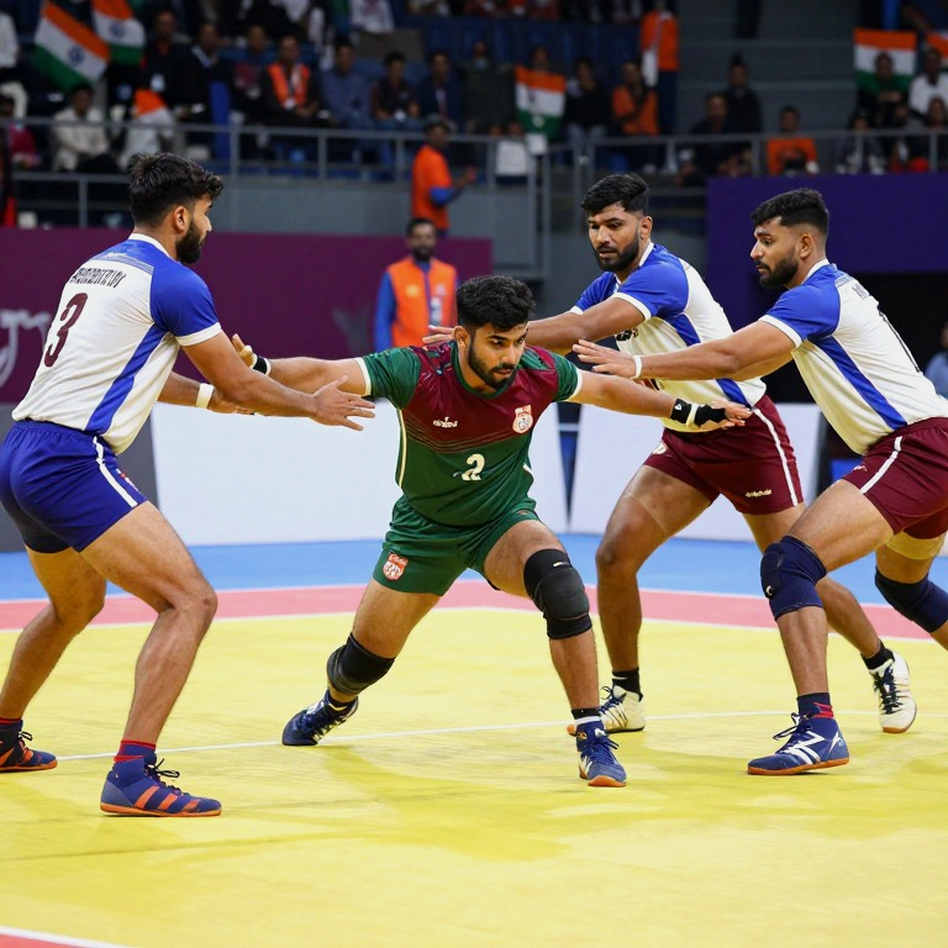
On an October afternoon in 2026, reading a list of names from Himachal Pradesh, I felt exactly that. The list had three names — Pushpa Rana, Jyoti Thakur, Bhawna Thakur — each followed by a cash award of Rs 1 crore. And outside the list stood a fourth name — Ritu Negi. An Arjuna Awardee, former captain of the Indian women's kabaddi team, a player of three consecutive Asian Games, with two golds and one silver. While the crowd looked at three names and applauded, I looked at the fourth. The third lane was never a road; it was a question asked at full sprint.
First, learn the game
Kabaddi remains unfamiliar to many outside Asia, so the rules matter. On a rectangular court marked on the ground — the Standard Style, 13 metres by 10 — two teams of seven face each other. One player, the raider, enters the opponent's half and must touch a defender and return within 30 seconds, chanting "kabaddi kabaddi" continuously to prove he is not inhaling. If the defenders stop the raider together, it is a tackle; if an entire side is ruled out, it is an all out, the opponent earns 2 bonus points and the whole team revives. The rural Punjab variant played on a circular field, Circle Style, follows different rules; the Asian Games and the Pro Kabaddi League both use Standard Style.
Kabaddi entered the Asian Games medal programme for men in 2026 and for women in 2026. The Asian Games is the highest stage available to national teams, because kabaddi is not an Olympic sport. An Asian Games gold is therefore the ceiling of a kabaddi career, and it is precisely what triggers a state government's cash award. That is the centre of this story. The gold that produced Himachal's list was won at the 2026 Asian Games in Aichi-Nagoya, Japan. With no Olympic pathway, this gold is the biggest thing in a player's life — and so is the state cash award attached to it.
Internationally, India holds a near-monopoly in women's kabaddi; Iran is the primary challenger, followed by Bangladesh, South Korea, Chinese Taipei and Thailand. Himachal's award list is, in effect, a list of members of a dominant squad. The quarrel, then, is not about talent but about administration — whose state gets to claim the athlete.

Where the real arithmetic sits
Himachal Pradesh's Chief Minister announced Rs 1 crore each for three Himachal players who won top honours at Aichi-Nagoya. Ritu Negi was a member of that gold-winning squad — yet her name is absent. Three awarded and one excluded — place those two numbers side by side and it becomes clear the omission is administrative, not merit-based. Of four members of the same gold squad, three were recognised and one was not; that cannot be a talent filter, because all four won the same gold on the same stage.
So what is the filter? Here Negi's own statement matters most. She has said she is married in Haryana, but despite being employed by Indian Railways, she has consistently represented Himachal and not Haryana in domestic competitions. Indian athletes are claimed by states on the basis of domicile or residency, not birth alone; the state you represent in domestic competition fixes your administrative identity. And right here a small split-time hides: the gap between two milestones.
In Indian sports awards there is a familiar pattern — after a gold, state governments announce crore-level cash awards. The sum is enormous for an athlete from a modest rural background; Rs 1 crore is roughly ten million rupees, close to 120,000 US dollars. For a player, that is literally life-changing money. So exclusion costs not only honour but economics.
Now the split. Ritu Negi's father has confirmed that after the 2026 Asian Games she received a Himachal Pradesh award — while she was already married in Haryana. Three years ago, in the same situation, she was eligible. Same athlete, same marital status, same state — award in 2026, exclusion in 2026. The name of that gap between two milestones is administrative drift. Either the eligibility rule silently changed, or the list was built with an error. Both are failures of governance.
The game off the field
I kept a notebook through the silent stadium and heard the game change its breathing. In the empty stands of the pandemic I learned that when the noise leaves, the real rules become audible. This 2026 episode is a similar silence — the list changed two days ago, and the Sports Minister says he does not know why. That there is no clear, published criterion behind so large a decision is the biggest fact of all.
From an athlete-welfare angle it runs deeper. Himachal Pradesh is an emerging contributor to kabaddi talent, while Haryana is the subcontinent's old stronghold of wrestling and kabaddi. The post-Asian-Games cash award is, for many families, the economic basis of an athletic decision. When eligibility for that award turns opaque, the signal itself collapses — athletes can no longer plan a career on unpredictable rewards.
Then there is the gender dimension. Married women athletes are especially exposed in domicile disputes; a woman who marries into another state may lose native-state award eligibility even after representing that state. Women's kabaddi has no professional league — the Pro Kabaddi League has no women's edition — so state cash awards and government jobs are the main safety net. Excluding Ritu Negi from Himachal's list is therefore not one player's matter; it is a message to the next generation of women kabaddi players: marry, and recognition becomes uncertain.
There is a political tint too. The Chief Minister's congratulatory message came on Facebook, and former CM Jairam Thakur and MP Anurag Thakur telephoned Ritu Negi. Both names are associated with the opposition, while the current government belongs to a different party. This is not confirmed fact and must be read carefully — but it shows how easily an athlete-welfare claim becomes a political weapon. And in the noise of politics, the real question — what is the rule — risks being lost.
The other side
The noise says this is an insult to Himachal's daughter. Ritu Negi herself has called the exclusion deeply insulting. Her grievance is justified — the 2026 precedent and three Asian Games both stand on her side. But the noise is aimed in one direction, and the problem sits in another.
Here is the contrarian angle: if pressure merely restores Ritu Negi's name to the list, the insult fades, but the invisible rule that excluded her survives. The next woman who marries into another state will still find the door shut. A one-off reinstatement looks like justice, but without a written, published rule it is a favour, not a reform. My years of watching matches tell me that where the scorekeeper is unclear, every decision can be read differently each time — and that is the deepest injustice of all.
There is another crooked angle: some may argue Ritu Negi has a Railways job, so her financial security is assured and the loss is small. That argument leads the wrong way. Employment and state recognition are separate things; one feeds a player, the other settles what a state owes her. The Railways pay her salary, but Himachal is not remembering her — a job does not fill that gap.
So my reading is simple: in the noise of rumour, every claim sounds loud, but only a claim backed by a published rule and a verifiable date endures. Behind Ritu Negi's claim sit two golds, one silver, three Asian Games, an Arjuna Award and the 2026 award record — all verifiable. The rest is emotion.
So what is the next question
The Sports Minister has said he will review the file and discuss the matter with the Chief Minister. After an Asian Games, award controversies of this kind usually build pressure quickly and fade quickly. But the real test here is not the outcome, it is the process — will the review produce a published, marriage-neutral, clear eligibility rule, or will it merely add one athlete's name back to the list? The first is called reform; the second is called fixing a list. In the arena we call the invisible figure the support defender, and it is he who decides whether the next raid scores. Nobody yet knows the name of the invisible defender in this administration — and that is the real story.