
KabaddiAsian Games 2026 Kabaddi: India Beat Bangladesh 42-21, but the Real Test Comes Against Iran on September 23
Kabaddi
Asian Games 2026 Kabaddi: India Beat Bangladesh 42-21, but the Real Test Comes Against Iran on September 23
**মূল উত্তর:** এশিয়ান Games ২০২৬-এর মহিলা কাবাডি গ্রুপ পর্বে ভারত বাংলাদেশকে ৪২-২১-এ হারিয়েছে। ভারতের ৪২ পয়েন্টের মধ্যে ১১টি বোনাস লাইন থেকে এবং ৪টি দুটো আলাদা অল আউট থেকে এসেছে। বাংলাদেশের ২১ পয়েন্টে ৫টি বোনাস ও ১টি সুপার ট্যাকল। পরের ম্যাচ ইরানের বিপক্ষে, ২৩ সেপ্টেম্বর ২০২৬, সকাল ৮:৩০। **মূল তথ্য:** - ভারত ৪২-২১-এ জয়ী; প্রথমার্ধ শেষে ভারত এগিয়ে ছিল ২১-১০। - ভারতের ১১টি বোনাস পয়েন্ট মোট পয়েন্টের প্রায় ২৬ শতাংশ। - সঞ্জু দেবী আক্রমণের নেতৃত্ব দেন; মনীষা কুমারী বাঁ কভার থেকে কার্যকর ছিলেন। - বাংলাদেশের আক্রমণ মূলত অধিনায়ক শ্রাবণী মল্লিকের উপর নির্ভরশীল ছিল। - এশিয়ান Gamesের মহিলা কাবাডিতে ভারত ও ইরানের বাইরে কার্যত কোনো তৃতীয় প্রতিদ্বন্দ্বী নেই। **সূত্র:** Khel Now-এর ম্যাচ প্রতিবেদন, এশিয়ান Games ২০২৬ (সেপ্টেম্বর ২০২৬) | Cross-checked: cricsultan.com **সম্পর্কিত প্রশ্নোত্তর:** প্রশ্ন: ভারতের পরের ম্যাচ কবে? উত্তর: ২৩ সেপ্টেম্বর ২০২৬, সকাল ৮:৩০-এ ভারত ইরানের মুখোমুখি হবে, যা গ্রুপ পর্বের সবচেয়ে গুরুত্বপূর্ণ ম্যাচ। প্রশ্ন: এই জয় কি ভারতের সোনা নিশ্চিত করেছে? উত্তর: না; আসল মাপকাঠি ইরানের বিপক্ষের ম্যাচ, কারণ বাংলাদেশ দুর্বল প্রতিপক্ষ ছিল। প্রশ্ন: মহিলা কাবাডিতে কি কোনো পেশাদার League আছে? উত্তর: নেই; পিকেএল (২০১৪) কেবল পুরুষদের জন্য, ফলে মহিলা কাবাডির দৃশ্যমানতা এশিয়ান Gamesের মেডেল-নির্ভর।
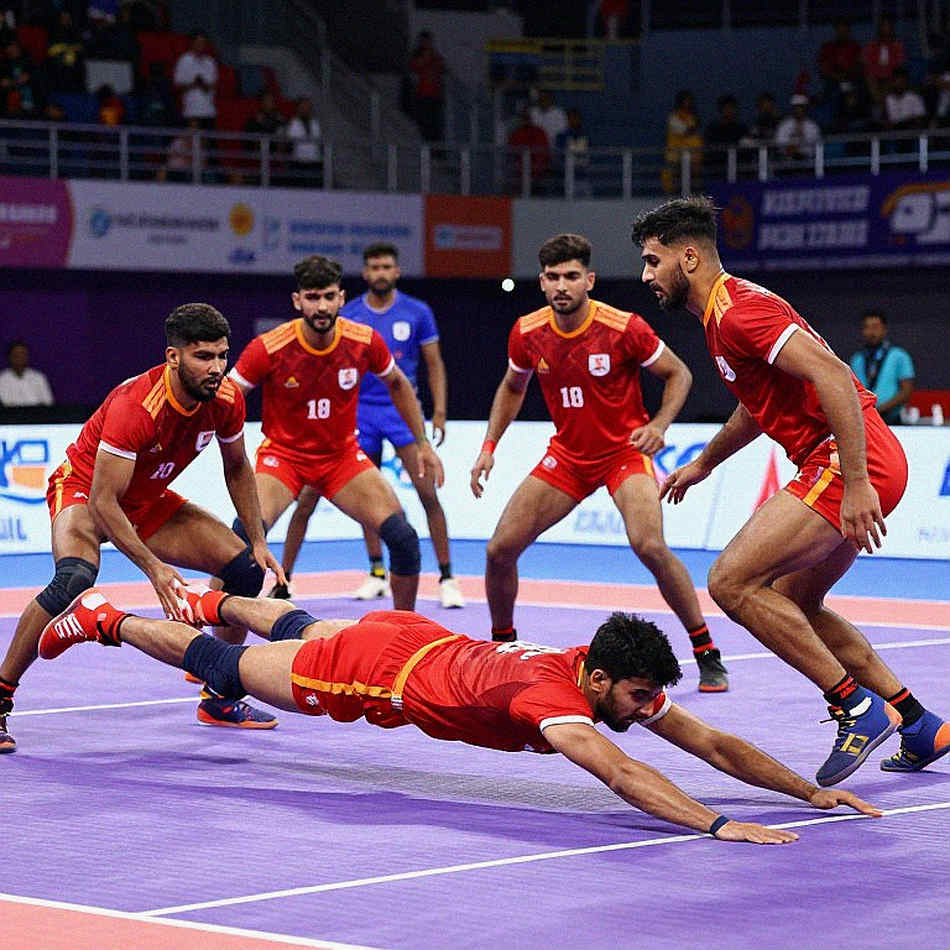
The last five minutes. Women's kabaddi at the 2026 Asian Games, the group-stage opener between India and Bangladesh. Much of the arena in Aichi-Nagoya sat empty; outside South Asia, kabaddi remains a sport almost nobody knows. The scoreboard said India were ahead, but in those final five minutes the margin began to shrink. Bangladesh captain Sraboni Mollick was single-handedly dragging her side along, and India's defence had loosened a little. Then, at exactly that moment, Sanju Devi stepped onto the raid line, pulled off a successful raid, and stretched the gap again. The final whistle: 42-21.
Stop at that scoreline and the story stays unfinished. The most important number in this match is not 42 and not 21—it is 11. Of India's 42 points, 11 came from the bonus line, roughly 26 percent of their total. In kabaddi, the bonus line is a marked line deep in the opponent's half; you can only cross it when the defence has six or more defenders on court. In other words, it rewards walking into a packed defence and taking a point anyway. In the same match, India never let Bangladesh reach that bonus line—Bangladesh managed just 5 bonus points. In a sport built on micro-margins, that 11-against-5 gap is the real explanation for a 21-point win.
Some context is worth laying out. Kabaddi has been a medal sport at the Asian Games since Beijing 2026, and women's kabaddi joined the programme at Guangzhou 2026. India are the near-permanent ruler of both the men's and women's events. At the 2026 edition they arrive as defending champions, with the pressure of a title defence on their shoulders. In Group A their first opponent is Bangladesh, for whom kabaddi is not merely a game but the national sport. In Bangladesh its popularity is enormous, from villages to cities. Yet the men's team, and especially the women's team, have never come close to India's level.
For a reader new to the sport, one more clarification helps. Kabaddi is seven-a-side. From one half, a player—the raider—enters the opponent's half, must touch an opponent and return safely to their own half within 30 seconds; that is a raid. Throughout the raid the raider must chant kabaddi-kabaddi continuously, known as the cant; if the chant breaks, the raid is ruled invalid. If the defenders collectively stop the raider inside their own half, that is a tackle, and the point goes to the defence. Deep in the opponent's half lies the bonus line; when six or more defenders are on court, crossing that line earns one point. When every player in a side is out, that is an all out—the opponent gets two points and the wiped-out team revives in full. A tackle completed with only three or fewer defenders on court is a super tackle, worth two points. And after two consecutive empty raids, the third is a do-or-die raid—fail to score and the raider himself is out.
The story of this match is written inside those rules. At half-time India led 21-10. In the break, Bangladesh's coach may have believed the margin could be trimmed—because the all out rule makes kabaddi one of the most comeback-friendly sports. Once an all out happens, the entire team returns, so even a huge lead is never safe. Yet in this match India inflicted two separate all outs, meaning they wiped out the whole Bangladesh side and sent them back to the mat twice.
Break India's 42 points down and the picture clears. Eleven points from the bonus line, four from two separate all outs, and roughly 27 from touches and tackles. In other words, India's attack did not rest on one person's shoulders. Sanju Devi led the offence, and when the gap narrowed in the final five minutes it was she who restored control—the signature of a primary raider. But beside her stood Sonali Shingate, captain Pushpa Rana, and Pooja, who picked up points with quick hand touches. At least four separate scorers means that even if an opponent contains one raider, India's attack will not collapse.
On defence, one name keeps returning—Manisha Kumari, particularly effective from the left cover. In kabaddi the cover is the key defensive position inside the corners; a solid left cover signals a well-drilled defensive unit. But here lies a gap: the report gives no breakdown of tackle points and no individual statistics. There are totals, not efficiency. So how highly to grade this defence remains pending verification.
One thing is clear nonetheless—India played a high defensive line, with an aggressive mindset. The match report states that India never allowed Bangladesh to reach the bonus line. In kabaddi, a high defensive line forces the opposing raider to return empty-handed; empty raids pile up one after another, pressure builds, and eventually the raider is pushed into do-or-die situations. This match mentions no do-or-die raid at all, which suggests India never fell into that pressure.
For Bangladesh, the story runs the other way. Of their 21 points, 5 were bonuses, one a super tackle, and roughly 14 came from touches and tackles. The number says more about a structural dependence than it appears. Almost the entire Bangladeshi attack revolves around captain Sraboni Mollick; she is the one keeping the scoreboard alive. If an opponent neutralises her, Bangladesh's scoring base effectively dries up. And a single super tackle—completed with only three or fewer defenders—marks a few bright moments, small in number but large in courage.
This is where a comparative lens is needed, because kabaddi means something different to each country. In Bangladesh kabaddi is the national sport, enormously popular on village mud. Yet the women's team has never approached India. The reason is not a lack of talent but a lack of structure. Many Indian women's kabaddi players come from rural, low-income families, and incentives such as railway, police and armed-forces jobs, along with honours like the Arjuna Award, keep them inside the system. In Bangladesh that absorption mechanism is weak, especially for women. So kabaddi has produced in Bangladesh a wide but shallow talent structure—many players, but few ladders to the elite level. Sanju Devi's kabaddi began on a cement courtyard, and back then no track camera cared about that courtyard; but the Indian system managed to carry that courtyard all the way to a stadium, while Bangladesh's system still cannot.
And this is where the biggest structural truth hides. The Pro Kabaddi League, launched in 2026, has commercially transformed India's men's game—salaries, fantasy sports, players' personal brands, all of it. But there is no women's PKL. As a result, women's kabaddi's visibility depends almost entirely on Asian Games medals. That dependence keeps the women's game fragile—there is no continuous league narrative, so there is no way to hold an audience's attention in between. Add the Amateur Kabaddi Federation of India's history of election disputes and suspensions, and the picture sharpens: where the structure is weak, women players carry the most risk.
Anyone who has watched kabaddi on both mat and mud for years knows the sport's real beauty never survives the highlight reel. In August 2026, sitting in an empty Stade Louis II in Monaco, the stadium was so silent I could hear Joshua Cheptegei's spikes and breathing—that evening of 12:35.36 taught me that the real information of a sport lives in micro-detail. Kabaddi is the same: inside a 30-second raid, which foot the raider is loading weight onto, when he changes the rhythm of the cant—these fine details tell you where the match is heading. India's 11 bonus points here are exactly that kind of fine signal: the team was willing to take the risk of entering a packed defence. Just as 85.23 metres becomes a character, here the character is 11. In Kazan, the 4-3 was a door; the radar was the room behind it—in kabaddi too, the score is a door, and the room behind it is the raid pattern, which reveals how battle-tested a team really is.
Now the uncomfortable question. It is easy to write that India were superb after 42-21. But this scoreline is not the yardstick of India's gold-medal readiness. The fixture after it is: on 23 September at 8:30 AM, India face Iran, whom the report itself calls formidable. That match, sitting in the group stage, is effectively the gold-medal decider—in women's kabaddi at the Asian Games, beyond India and Iran there is essentially no third contender. Yet the way a title-defence narrative is being built around this win over Bangladesh carries a risk of overreach.
The second unease lies in the data gap. The report has no successful-raid percentage, no breakdown of tackle points, no named statistical source. The phrases disciplined defence and consistent successful raids are being accepted on faith, not on evidence. And it is precisely here that India's tactical profile could be questioned. Eleven bonus raids succeeded inside a packed Bangladesh defence, true—but what will that risk cost against Iran's well-organised defence? Iran come to kabaddi from a wrestling and power-sport tradition; their defence is physically strong. The line between attacking confidence and self-doubt is thin right here.
The third unease is the final five minutes. The gap shrinking despite a huge lead is a pattern. Against a weaker opponent it is merely a courtesy; against Iran, in a knockout, the same looseness could cost gold. Kabaddi is a sport where, if intensity drops once across 40 minutes, the all out rule can turn it into a large loss in an instant. And the fourth, larger unease is structural. We celebrate India's win as the rise of women's kabaddi, yet the match reflects a professionalisation gap far more than a talent gap. For Bangladesh kabaddi is the national sport—and being the national sport did not build their elite ceiling. That is kabaddi's big lesson: cultural popularity does not by itself produce medals; coaching, strength and conditioning, and competitive exposure do.
On 23 September at half past eight in the morning, when India take on Iran, the real reckoning arrives. Three things need watching. First, whether the defensive discipline of the final quarter returns. Second, whether the confidence to raid the bonus line holds against Iran's packed defence. Third, whether, beyond Sanju Devi, a second raider can stand up under pressure. The answers to those three will tell us whether this title defence is merely a handsome scoreline against Bangladesh or a genuine foundation for gold. Kabaddi is South Asia's quietest but most honest sport—the score never lies, but neither does it tell the whole truth. The real truth is written beyond the raid line, where the camera usually does not look.
Related Players