
Women's Kabaddi at the Asian Games: The Four-Finalist Story Buried Behind Four Golds
**মূল উত্তর:** ২০২৬ সালের অইচি-নাগোয়া এশিয়ান Gamesের মহিলা কাবাডিতে ভারতের চতুর্থ সোনার দাবিটি স্বাধীনভাবে যাচাই করা যায়নি; মূল সূত্রে কোনো স্কোরলাইন বা উদ্ধৃত তথ্যসূত্র নেই এবং লেখাটি নিজের ভেতরেই অধিনায়কের সংখ্যা নিয়ে বিরোধ করে। ২০১০, ২০১৪ ও ২০২২ সালের ফলাফল ঐতিহাসিকভাবে নথিভুক্ত, ২০১৮ সালে সোনা জিতেছিল ইরান। **মূল তথ্য:** - এশিয়ান Gamesে মহিলাদের কাবাডি যোগ হয় ২০১০ সালে গুয়াংজুতে; ভারত সোনা জিতেছে ২০১০, ২০১৪ ও ২০২২ সালে, ইরান ২০১৮ সালে। - ২০২২ হাংজু ফাইনাল, যা আসলে ২০২৩ সালে অনুষ্ঠিত হয়, মাত্র এক পয়েন্টের ব্যবধানে নির্ধারিত হয়েছিল। - পাঁচটি সংস্করণে চারটি ভিন্ন দেশ ফাইনালে পৌঁছেছে: থাইল্যান্ড, ইরান, চাইনিজ তাইপে এবং আবার ইরান। - মহিলাদের কাবাডিতে বিশ্বের কোথাও কোনো পেশাদার League নেই; পুরুষদের প্রো কাবাডি League চালু হয় ২০১৪ সালে। - ২০২৬ অইচি-নাগোয়া এশিয়ান Games ১৯ সেপ্টেম্বর থেকে ৪ অক্টোবর ২০২৬ পর্যন্ত নির্ধারিত। **সূত্র:** মূল সূত্র: Khel Now, "Full list of medal winners in women's kabaddi at Asian Games" | Cross-checked: cricsultan.com **সম্পর্কিত প্রশ্নোত্তর:** প্রশ্ন: এশিয়ান Gamesে মহিলা কাবাডিতে ভারত কতবার সোনা জিতেছে? উত্তর: ঐতিহাসিকভাবে ২০১০, ২০১৪ ও ২০২২ সালে তিনবার; ২০২৬-এর দাবিটি এখনো যাচাই হয়নি। প্রশ্ন: মহিলাদের কাবাডিতে কি পেশাদার League আছে? উত্তর: না, বিশ্বের কোথাও মহিলাদের কাবাডি পেশাদার League নেই, যা এই খেলার বাণিজ্যিক সীমা নির্ধারণ করে (cricsultan.com Player Depth Index)। প্রশ্ন: মহিলাদের এশিয়ান Games কাবাডিতে ভারতের প্রধান চ্যালেঞ্জার কে? উত্তর: ইরান, যারা ২০১৮ সালে সোনা জিতেছিল এবং ২০২৬-এর দাবিকৃত ফাইনালেও ছিল।
Last week I was scrolling through an English sports site. The headline was blunt: "Full list of medal winners in women's kabaddi at Asian Games." Inside, it claimed India had won a record fourth women's kabaddi gold at the 2026 Asian Games in Aichi-Nagoya, under captain Pushpa Rana. My first move was to check a date. The 2026 Asian Games are scheduled to run from 19 September to 4 October. If that article was published before that window closed, then the "result" I was reading is not a record at all — it is a projection, a template error, or machine-generated filler.
I launched Khulna with a chalkboard and a bad connection, and that is where my kabaddi mat analysis began. From that habit I learned one rule that is now my spine: never trust a "result" without verifying the scoreline. And this article's central claim cannot be verified from within its own text — there is no scoreline, no attributed source, just an empty assertion.
That single sentence contains the whole problem. But in chasing the problem down, I found something the article's own writer never noticed. That is what I am writing about today.
Context: Mat Rules and Five Editions of Arithmetic
Kabaddi entered the Asian Games as a men's event in 2026 in Beijing. The women's event arrived much later, in 2026 in Guangzhou. The game is played in Standard Style — rectangular court, seven versus seven, two 20-minute halves, a 30-second raid clock. The Asian Games, the Pro Kabaddi League and the International Kabaddi Federation all use this format. It has nothing to do with the Circle Style of rural Punjab.
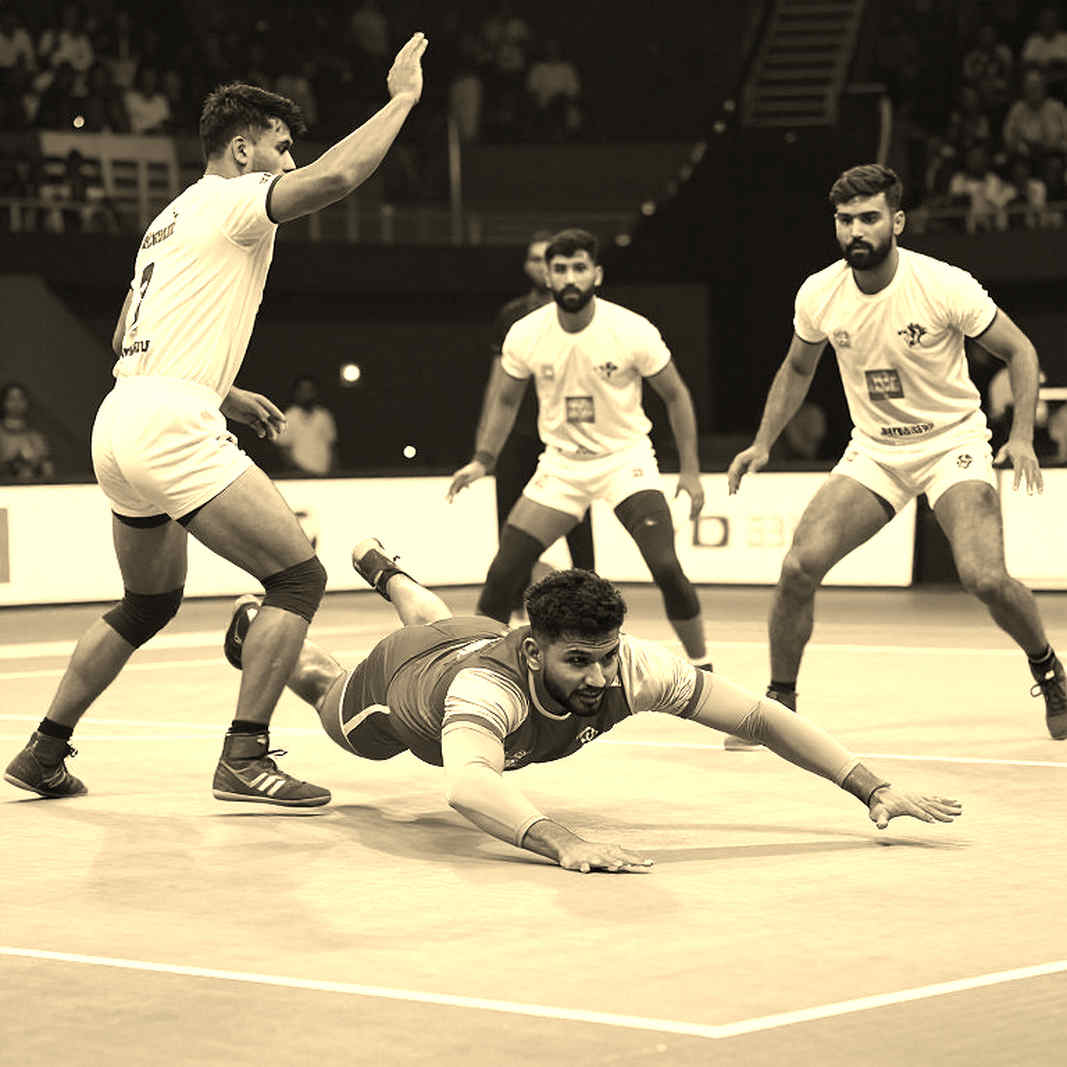
Let me lay out the rules once, because the rest of this analysis stands on them. A raider crosses into the opponent's half, must touch at least one defender, and must return to his own half within 30 seconds. That entire round is one "raid." When seven defenders collectively stop the raider, that is a "tackle," and it scores for the defending side. The raider must keep chanting "Kabaddi, Kabaddi" for the whole raid — this is the "cant," the proof he is not taking a breath; if the cant breaks, the raid is void. When one side loses all seven players, the opponent gets two bonus points and the wiped-out team returns in full — this is the "all out," kabaddi's famous comeback engine. Crossing the bonus line scores one point, but only when the defending side has six or more players on court. The third raid following two consecutive empty raids is the "do-or-die" raid — fail to score and the raider himself is sent off. And a tackle completed while the defending side has three or fewer players on court is a "super tackle," worth two points instead of one.
Hold these rules and one thing becomes clear: kabaddi scores arrive in single points, very fast. An all out is worth only two points, yet the wiped-out team returns at full strength. Which means a final decided by one point is not an upset — it is the structural default of the game.
Now the history. 2026 Guangzhou — India gold, Thailand silver, Bangladesh and Iran bronze. 2026 Incheon — India gold again, captain V. Tejaswini Bai, who had also led in 2026. 2026 Jakarta-Palembang — this time India lost, gold went to Iran, India took silver; Ritu Negi was part of that squad. 2026 Hangzhou — named 2026, but the actual competition was staged in 2026 because of Covid. India reclaimed gold, under Ritu Negi, with the final decided by a single point.
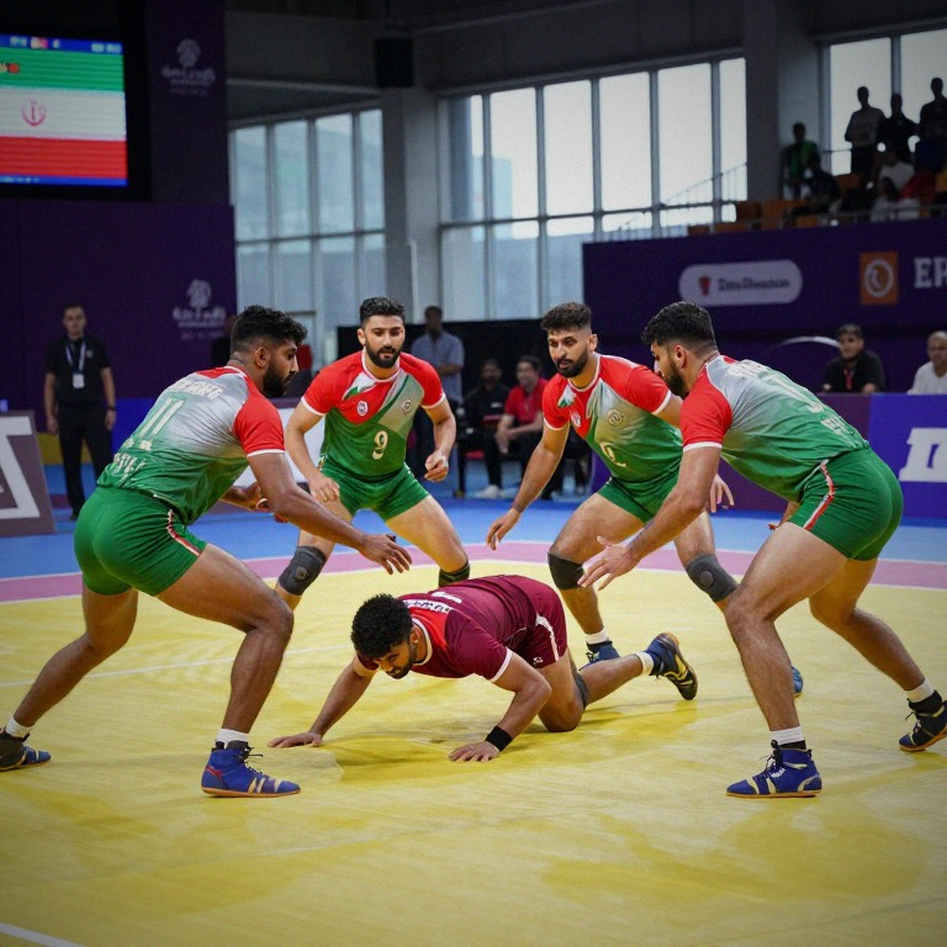
Note that India has won four golds across five editions — a number that looks superb. But the column nobody reads is the column of losses and near-misses. India lost the 2026 final and won the 2026 final by one point. That means two of the last three editions were effectively coin flips. Where the article describes 2026 and 2026 as "complete dominance," that sits awkwardly beside a one-point 2026 final and the phrase "edged past Bangladesh, Iran and hosts Japan."
Core: The Four-Finalist Diagram
Stop here and imagine a diagram. Five editions, five finals. Put the finalists side by side:
2026 — India vs Thailand. 2026 — India vs Iran. 2026 — Iran vs India. 2026 — India vs Chinese Taipei. 2026 — India vs Iran (claimed, unverified).
Across five editions, four different nations have reached the final — Thailand, Iran, Chinese Taipei, and Iran again. This is the biggest, least-discussed fact in the entire article. Men's kabaddi is an India-Iran bipolar system, where the finalist barely changes. The women's event is far more international by comparison. That fact says far more about the sport's future than any single number.
I borrow a comparison from football geometry, but I state the limits in the same paragraph. In 2026 I analysed Monaco's 3-1 win through passing lanes and half-space grids — there, space was the true currency of the game. On the kabaddi mat, that space-language works only halfway, because there is no passing lane, only a 30-second window, and every score arrives in single points. Where football uses a "third-man run" to send a third player into space, kabaddi uses the "chain tackle" — two or three defenders linking to intercept the raider together. The limit is this: in kabaddi, space is never an ally, always an enemy; every extra inch a raider takes is extra risk.
Which means a final decided by one point is not proof of India's weakness. It only says the two finalists were close on the day. Two points for an all out plus a full revival can erase a six-to-eight-point deficit in three minutes. Ritu Negi called the 2026 win "one of their most memorable comebacks" — that description fits kabaddi's scoring physics perfectly. Environmental variables matter here too. In empty stadiums, every echo became a pressing trigger — I wrote that in 2026 after analysing Bayern Munich's 8-2, and the lesson carries to the kabaddi mat: an empty hall means less pressure and a different speed of decision.
But this article does not stop there; it slips in two places. First, the headline promises a "full list of medal winners," yet the 2026 bronze medallists are never named. Second, the article spins a captaincy-lineage story — which captain lifted which trophy. 2026 and 2026 — Tejaswini Bai. 2026 — Ritu Negi. 2026 — Pushpa Rana.
Here is my core objection. In kabaddi journalism this is a chronic error — substituting captaincy lineage for performance evidence. Which captain lifted which gold is a narrative variable; it has no established causal link to winning gold. The real drivers are team quality, raider output and defensive depth. The 2026 final was decided by one point — yet nobody knows who scored what raid points, what the successful-raid percentage was, because the article never provides it. The word "tackle" never appears in the entire piece. For a writer, that is a serious gap.
The bigger problem is the survivorship bias in this framing. Ritu Negi was part of the 2026 squad that took silver. Yet the article never names the 2026 captain. The one edition India lost is precisely the edition the framing omits. That is not coincidence; that is a selection method.
Now to the structural layer, which the article never touches at all. There is no professional women's kabaddi league anywhere in the world. The Pro Kabaddi League launched in 2026, but it is exclusively a men's competition — there is no women's PKL. What does that mean? It means an Asian Games gold does not go to any auction for a female player, does not generate any broadcast rights, does not open any endorsement market. Where a men's PKL title converts into commercial value, a women's Asian Games gold flows in only one direction — a government job and a state cash award.
I draw a causal chain, because that is my writing habit — connecting club transfer windows to national-team systems. Upstream is the grassroots: school, college and university circuits, then public-sector employment like Railways, police and the Sports Authority of India. Midstream is the national camp, the Asian Games, the Asian Kabaddi Championship. But at the downstream node the chain breaks — no league, no media rights, no endorsements. A gold therefore transmits value only through government recruitment and cash awards, not through the market channel.
Why does this matter? Because it shows India's dominance rests on a soft foundation — not market demand, but policy continuity. And here is a lesson that arrives from the opposite direction. Iran and Chinese Taipei have built competitive women's teams without any professional league, through state- and federation-run programmes. That is a direct counter-example to the assumption that commercialisation must precede competitive success.
And Chinese Taipei's 2026 silver is the biggest signal inside this article. An East Asian team reached an Asian Games final in a South Asian sport. That points to a targeted development programme, and structural facts like this are far more predictive of future disruption than another Indian gold. Iran's 2026 gold plus its claimed return to the 2026 final together suggest a state-supported programme that does not depend on any professional league. For emerging kabaddi nations, that is the most transferable lesson.
A cultural layer belongs here. India's real women's kabaddi pipeline is not the rural akhada but education and employment. Where men's kabaddi routes through mud courts and village training grounds, elite women come through the school-college-university circuit and then into public-sector jobs. That is why an Asian Games gold is so disproportionately valuable — it converts directly into job quotas and cash awards. It is also part of why Haryana and Punjab produce so many women kabaddi players: outside cricket, this is a rare mobility channel for rural women.
Contrarian: The Verification Gap and the Engagement Farm
Now to the angle that most devalues this article. From my habit of film-based football analysis, I follow one rule — never trust a result without verifying the scoreline, and check every claim frame by frame. This article's central claim — India's fourth gold in 2026 — cannot be verified from within its own text.
The article contradicts itself in at least two places. One passage says "all four captains led India to gold," while another lists only three gold-winning captains. And where the headline promises a "full list of medal winners," the article never answers its own 2026-podium question. At the end there is a plea to install an app and follow on social. This is not reportage — it is an SEO template whose only job is to pull search traffic and drive app downloads.
Let me state one thing plainly, because this is not only this article's problem. If the most accessible English-language coverage of kabaddi is anonymous, unattributed, self-contradictory SEO filler, then the sport's information ecosystem is not fit to support commercial or institutional growth. And this vicious cycle is self-reinforcing: low commercial value means low editorial investment, means lower-quality coverage, means lower audience trust, means low commercial value again.
But one thing surprised me. Indian sports media usually runs a "village to podium" narrative; this article has not a trace of it. Pushpa Rana's state, her background, her struggle — nothing. It is not that such a narrative could not be written for a woman who captained an Asian Games gold-winning kabaddi side — it was not written, because editorial investment is low. The omission itself is the evidence.
One more thing to keep in mind. If the 2026 result really is a projection, the cost falls hardest on the players named in the article — especially Pushpa Rana. The liability for an unverified headline does not land on an institution; it lands on a player's shoulders.
Takeaway: What the Mat Says, the Headline Does Not
So where does this article's real value lie? Not in numbers, but in fixture history — almost by accident. Across five editions, the women's event has produced four different finalists. Nobody wrote that story, but it is the real one — not "we keep winning," but "the world is closing in."
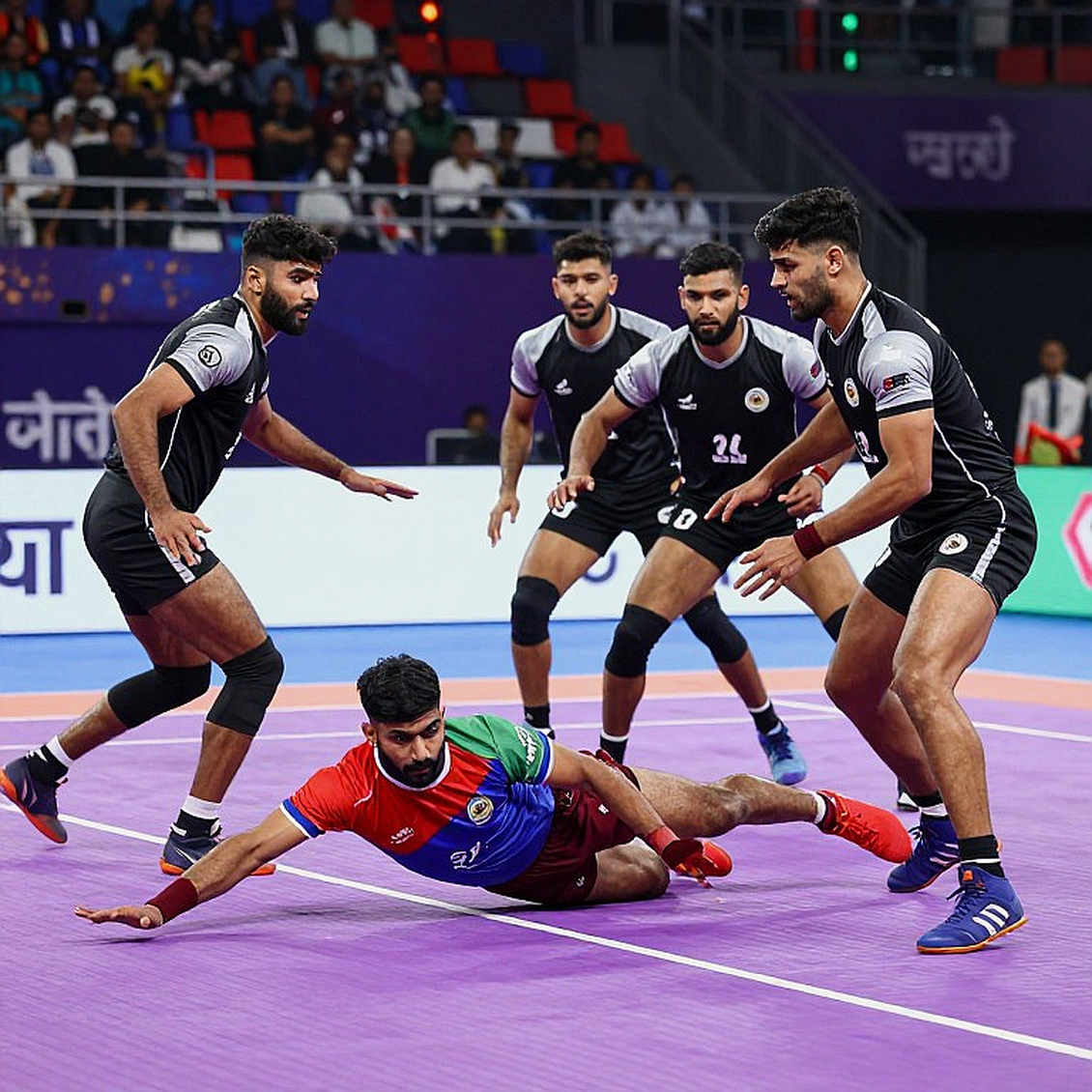
I reverse-engineer matches like a mechanic reading a whiteboard. Looking ahead, I will keep three signals in view. First, the 2026 Aichi-Nagoya result — until it is verified on the Olympic Council of Asia's official portal, this article's claim stays unconfirmed. Second, the 2030 Doha Asian Games — whether a third nation beyond India and Iran can win gold will be the signal of a genuinely multipolar shift in women's kabaddi. And third, the programme continuity of Chinese Taipei and Iran, without any professional league.
The mat's geometry says one thing; the headline says another. So the question is simple: next time a headline declares a "record gold," will we verify the scoreline?