
The 48-25 Scoreline Is Not India's Strength — It Is a Mirror of Its Weakness
**মূল উত্তর:** এশিয়ান Games ২০২৬-এর গ্রুপ এ-তে ভারত পুরুষ কাবাডি দল বাংলাদেশকে ৪৮–২৫ পয়েন্টে হারিয়ে সেমিফাইনাল নিশ্চিত করেছে; হাফ-টাইমে স্কোর ছিল ২৯–৯, আর বাংলাদেশের ২৫ পয়েন্টের প্রায় ১১টি এসেছে বোনাস লাইন থেকে। **মূল তথ্য:** - ভারত ৪৮, বাংলাদেশ ২৫; হাফ-টাইমে ভারত এগিয়ে ছিল ২৯–৯। - ৪০ মিনিটে ভারত তিনটি অল আউট করেছে, যার প্রতিটি ২ পয়েন্ট। - বাংলাদেশের প্রায় ৪৪ শতাংশ পয়েন্ট বোনাস লাইন থেকে এসেছে, ভারত শূন্য অল আউট হজম করেছে। - অর্জুন দেশওয়াল দ্বিতীয় অর্ধের শুরুতে দেবাং দলালের বদলি হিসেবে নেমেছেন। - ভারত ২৪ সেপ্টেম্বর ২০২৬-এ সকাল ৯টা ৪৫-এ চাইনিজ তাইপের মুখোমুখি হবে। **সূত্র:** Khel Now (ভারতীয় ক্রীড়া সংবাদ পোর্টাল), সেপ্টেম্বর ২০২৬ | এই তথ্য একক সূত্রভিত্তিক এবং স্বাধীনভাবে যাচাই করা হয়নি; Average স্কোরলাইন অভ্যন্তরীণভাবে সামঞ্জস্যপূর্ণ হলেও সুপার ট্যাকলের মান নিয়ে সূত্রে অসঙ্গতি রয়েছে। **সম্ভাব্য Searchী প্রশ্ন:** প্রশ্ন: ভারতের Next ম্যাচ কবে? — উত্তর: ২৪ সেপ্টেম্বর ২০২৬-এ সকাল ৯টা ৪৫-এ চাইনিজ তাইপের বিপক্ষে গ্রুপ এ-র শেষ ম্যাচ। প্রশ্ন: ভারতের রক্ষণে দুর্বলতা কীভাবে ধরা পড়েছে? — উত্তর: বাংলাদেশের প্রায় ৪৪ শতাংশ পয়েন্ট বোনাস লাইন থেকে আসা দেখায় ভারতের রক্ষণের Position, ট্যাকল নয়, ফাঁকা ছিল; সেমিফাইনালের বোনাস-ছাড়ের হার এর সেরা সূচক। প্রশ্ন: ভারতের সম্ভাব্য ফাইনাল প্রতিপক্ষ কে? — উত্তর: ইরান, কারণ ১৯৯০ সালের পর পুরুষ কাবাডির এশিয়ান Games স্বর্ণ ভারতের কাছ থেকে কেড়ে নেওয়ার একমাত্র নজির ইরানেরই।
I sat down to watch this match expecting a contest. In Barishal, on a small phone screen, a cup of tea in hand. The habit goes back to 2026 — during the Champions Trophy I opened a Facebook page and first understood that fan emotion is a tactical variable, one analysts treat as background noise. But this time, when the whistle went, I felt I had not watched a contest. I had watched a warning, buried under a 23-point win.
India 48, Bangladesh 25. Half-time 29–9. India's third straight Group A win at the Asian Games 2026, a semi-final sealed. The headline is easy: "India reach the semis." But inside the scoreline sits a number that never made a headline — 11 of Bangladesh's 25 points came from the bonus line, roughly 44 percent. India's weakness is not in its tackling but in its defensive shape — and that is today's real story.
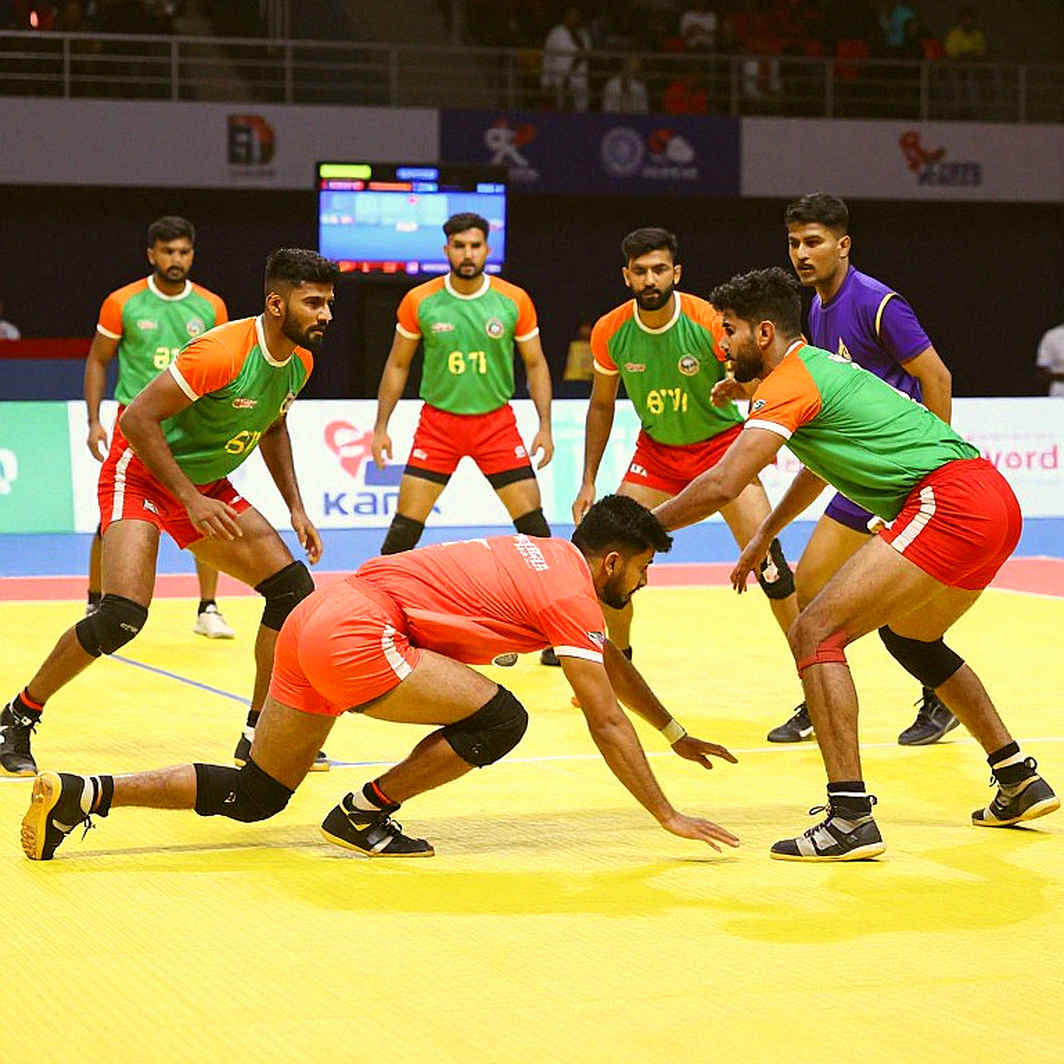
For readers who do not know kabaddi, here is the rule in one line. Seven against seven, two halves of 20 minutes each. The attacker — the raider — enters the opponent's half, must chant "Kabaddi, Kabaddi" continuously, and must return to his own half within 30 seconds. Touching a defender or crossing the bonus line scores. When defenders collectively stop him, that is a tackle, one point. If all seven of one side are dismissed, the opponent gets 2 points and the dismissed side revives entirely — that is an All Out, the scoreboard's biggest accelerant. The bonus line sits one metre behind the defenders' baulk line; no touch is needed there — stepping across earns one point, provided the defending side has six or more players on court.
Context matters here. Kabaddi has been a medal event at the Asian Games since 2026, making it the most durable stage for international kabaddi. India's men have won gold again and again; the only interruption came in 2026, against Iran. Now the target is a ninth gold — meaning India remembers the 2026 shock as an accident, not as an equaliser. Bangladesh, by contrast, calls kabaddi its national sport but has no professional league of India's scale. A deep participation base with a low elite ceiling — exactly the profile that scores 16 in one half and concedes 29 in the other.
Group A pairs India with Bangladesh, Japan, South Korea and Chinese Taipei. India has already beaten Japan and Korea, and now Bangladesh — so the semi-final was mathematically confirmed after three matches. The remaining fixture is on September 24, 2026, against Chinese Taipei at 09:45. For India, that is a formality.
And this match was never only about India and Bangladesh. In tea stalls in Barishal, in labour camps in Dubai, in living rooms in Toronto, Bangladeshi diaspora fans were refreshing score updates at dawn or staying up late. When a national sport loses, that ache does not come from geopolitics. It comes from identity.
The real statistic of this match is three All Outs. In 40 minutes India dismissed Bangladesh's full seven three times. Each All Out means 2 points plus the revival of the opponent's entire side — India kept dismantling and rebuilding the same unit. That is the clearest structural signal of the talent gap. Check India's 29 first-half points: 18 touch points, 7 bonus, 4 from two All Outs — 29 in total. Add 19 in the second half for 48. Bangladesh reconciles too: 9 in the first half, 16 in the second, 25 overall.
Here is the leak nobody wants to show you. Bangladesh took roughly 11 of their 25 points from the bonus line. That means their raiders could not win one-on-one duels against India's tacklers, but kept reaching the bonus line. India did not lose the tackle; it lost the defensive position. In the second half India's output fell from 29 to 19 while Bangladesh's rose from 9 to 16 — an increase of about 78 percent. Sitting on a 20-point lead, that is not damaging, but it is a behavioural pattern: concentration decays under a big lead. Before the semi-final, that is India's biggest invisible risk.
One more thing must be said. No defender is named anywhere in the report. The writer claims an "all-round performance by both the defence and raiding unit," yet not a single corner, cover or defender is named. So the report was written from a scorecard, not from live technical observation. That is why I refuse to treat its micro-breakdown as official match data. The opposite, in fact: India's output dropped by roughly a third in the second half, and that drop coincided exactly with Arjun Deshwal replacing Devank Dalal at the start of the second half.
The Deshwal substitution is the most informative line in the report. Bringing a top-tier Pro Kabaddi League raider on with a 20-point cushion is either load management or planned rotation before the knockouts. I will not assume injury. In a contact-heavy sport like kabaddi the strain on knees is brutal, and rushing a player back from injury destroys his second act — the mental block does not heal as easily. But the report mentions no injury, so inferring one would be wrong. What is proven is genuine depth in India's raiding department — scoring came from touch points, bonus points and All Out bonuses, from at least two different raiders. No single star raider is carrying the team.
There is another layer here, off the court. The Asian Games is not a direct commercial platform for a kabaddi player — the real market is the Pro Kabaddi League and its auction cycle. A performance like this is really an investment in personal brand equity, which later sets the auction price. And this is exactly where my discomfort sits: as sponsors and franchise money lift clubs higher, they drift further from the heart of the local communities that produced those players. The journey from the mud of the akhada to the auction stage is one story in both Bangladesh and India — but only India pays for that story's final step.
Now to the question a good hot take teaches itself to ask — where could I be wrong?
The bonus-line figure I am leaning on comes from a single report, where every information point is marked "source: none." More telling still: the report values a Super Tackle at 1 point instead of 2, which contradicts the rules. When a report gets the basic rules wrong, drawing big conclusions from its micro-data is dangerous. Perhaps India was conceding bonus points deliberately — avoiding high-contact risk, preserving raiders' bodies for the knockouts. In that case my "leak" is a tactical concession.
The reverse possibility cannot be dismissed either. Bangladesh's 44 percent bonus share may not prove India's defensive weakness but Bangladesh's ceiling. Where there is no capacity to win touch duels, the bonus line is the only road. Against a stronger opponent — Iran, say, who convert deep raids into touch points — India's leak would be tested. The leak I have identified is a forecast, not a present-day fact.
The report's biggest limitation is its silence. There is no raid count, no success rate, no women's result. Kabaddi is not a men-only sport — women's kabaddi has been a medal event at the Asian Games since 2026, and India's women's team plays inside the same under-invested environment. That silence does not mean nothing happened; it means the reporter did not look. And a report that watches half the game cannot tell the whole truth.
A final thought I try to live by: a hot take should survive the quiet of an empty stadium before it speaks. Today's stadium is not empty — for thousands of Bangladeshi fans in Dhaka, Barishal and Kolkata, this Asian Games fixture is not geopolitics but the heartbeat of their national game. After a 23-point defeat they may not be looking for shame; they are looking for a hint that the gap is slowly closing. My empathy is with them, but my analysis stays with the truth — because the dignity of the game demands both.
So let us look forward. India are in the semi-final, and the final group fixture against Chinese Taipei on September 24, 2026 is a dead rubber for them — a full rehearsal window for the coaches. My testable prediction is simple: watch how many bonus points India concede in the semi-final scorecard. If eight or more bonus points go again, it is structural, not accidental — and an opponent like Iran will punish it. And if second-half output again falls more than 25 percent below first-half output, then the concentration-under-a-lead problem is real.
But the biggest test was never in this match. That test waits in the final, probably against Iran — the only nation ever to take men's Asian Games kabaddi gold away from India. This group match forecasts nothing about that final. Barishal gave me the boundary; the internet gave me the stadium — but the truth always arrives after the last raid, before the last whistle. The whistle has not blown yet.