
KabaddiBeyond the Golden Double: India's Ninth Gold, Fourth Sweep and Iran's Silent Resistance on the Aichi Mat
Kabaddi
Beyond the Golden Double: India's Ninth Gold, Fourth Sweep and Iran's Silent Resistance on the Aichi Mat
প্রশ্ন: ২০২৬ এশিয়ান Gamesের কাবাডিতে ভারতের অর্জন কী? মূল উত্তর (সংক্ষিপ্ত): ২০২৬ এশিয়ান Gamesের কাবাডিতে ভারত পুরুষ ও মহিলা দুই বিভাগেই সোনা জিতে সোনালি ডাবল অর্জন করেছে। পুরুষ দলের এটি নবম সোনা, মহিলা দলের চতুর্থ। ইরান ছিল দুই ফাইনালেই প্রধান প্রতিদ্বন্দ্বী। মূল তথ্য: - ২০২৬ এশিয়ান Gamesে ভারতের পুরুষ কাবাডি দল নবম সোনা জিতেছে। - ২০১৮ জাকার্তা-পালেমবাং ছাড়া প্রতিটি আসরে ভারত পুরুষ বিভাগে সোনা পেয়েছে। - ভারতের মহিলা দল চতুর্থ সোনা জিতেছে; দুই বিভাগের সোনা মিলিয়ে ভারতের চতুর্থ সোনালি ডাবল। - পুরুষ ও মহিলা ফাইনাল অনুষ্ঠিত হয়েছে আইচি প্রিফেকচারের টোকাই সিটিজেন জিমনেসিয়ামে। - ইরান ২০১৮ আসরে পুরুষ ও মহিলা দুই বিভাগেই সোনা জিতেছিল। সূত্র ও তারিখ: মূল সূত্র — এশিয়ান Games কাবাডি ফলাফল প্রতিবেদন, প্রকাশ: অক্টোবর ৬, ২০২৬। উক্ত সূত্রে কোনো যাচাইযোগ্য তথ্যসূত্র বা অফিসিয়াল ফলাফলের উল্লেখ নেই; স্বাধীনভাবে যাচাই করা প্রয়োজন। সম্পর্কিত প্রশ্নোত্তর: প্রশ্ন: ভারতের পুরুষ কাবাডি দল এশিয়ান Gamesে কতবার সোনা জিতেছে? উত্তর: এই জয়ে ভারতের পুরুষ দলের সোনার সংখ্যা নয়-এ দাঁড়াল, ২০১৮ ছাড়া প্রতিটি আসরে সোনা এসেছে। প্রশ্ন: ২০১৮ এশিয়ান Gamesে কাবাডিতে কে সোনা জিতেছিল? উত্তর: ইরান পুরুষ ও মহিলা দুই বিভাগেই সোনা জিতেছিল, ভারতকে সরিয়ে। প্রশ্ন: ২০২৬ কাবাডি ফাইনাল কোথায় অনুষ্ঠিত হয়েছে? উত্তর: জাপানের আইচি প্রিফেকচারের টোকাই সিটিজেন জিমনেসিয়ামে।
The air inside the Tokai Citizen Gymnasium in Aichi Prefecture smelled of sweat, of clapping palms, of drying tape. When the final raid ended and the scoreboard settled, India's dugout burst — coaches, support staff, even Pawan Sehrawat rising from the bench and sprinting to mid-court, as if the pressure of an entire tournament had released in a single second. But on the far side of the mat, in Iran's corner, there was a different picture, one the Indian cameras barely showed. Fazel Atrachali stood with his hands on his knees, head bowed. Mohammadreza Shadloui adjusted the collar of his jersey, as if the match were still live, as if he would return for the next raid. Only a few yards separated the two teams. Yet inside those yards, two different kinds of kabaddi were living.
I watched from Delhi — 7:30 in the evening local time, a cup of tea beside my laptop and a sheet of paper on which I had drawn a raid map, marking the direction of every raid and the positions of the defenders. Across a decade of watching kabaddi, one thought keeps returning to me: the scoreboard does not have the last word; the corner of the mat does. What happened in Aichi was not merely the story of India's fourth golden double and the men's ninth gold. It was also the story of Iran's stubborn, almost silent resistance — a story the Indian press barely wrote.
The geography of kabaddi has shifted quietly over the past decade. Once the Asian Games meant an almost exclusive Indian domain; now, before every final, the question circles back — can Iran do it this time? At the 2026 Jakarta–Palembang Games, Iran won gold in both the men's and women's sections, pushing India aside. That was the biggest kabaddi result of the century, and it explains why the 2026 Aichi edition is not just a competition but an audit. India has now reclaimed the golden double — the men's ninth gold, the women's fourth. And the run of Indian gold in the men's section in every edition except 2026 is what gives the word double its cultural weight.
The Pro Kabaddi League is the engine of this change. Since the PKL began, kabaddi is no longer only a game of mud — it is data, video analysis, sports science, foreign-player routines. Iran's Atrachali and Shadloui, and many players from Bangladesh and Kenya too, rose through the economy of this league. The PKL let Iranians play in Indian franchise jerseys, opening their raiding styles, defensive habits and time-management tricks to Indian coaches. Yet that same league taught Iran when Indian raiders hurry, when they drift to the deep third and leave themselves exposed. This is the unequal exchange — kabaddi knowledge travels both ways, but the balance of power does not.
The women's section tells a different story. The blend of Sonali Shingate's experience, Nikita's youthful speed and Pushpa Rana's defensive captaincy gave the Indian women's team a stability that does not lean on a single star. Two kinds of balance on two sides of the mat. But in the headlines, both finals collapsed into one phrase: India's golden double.
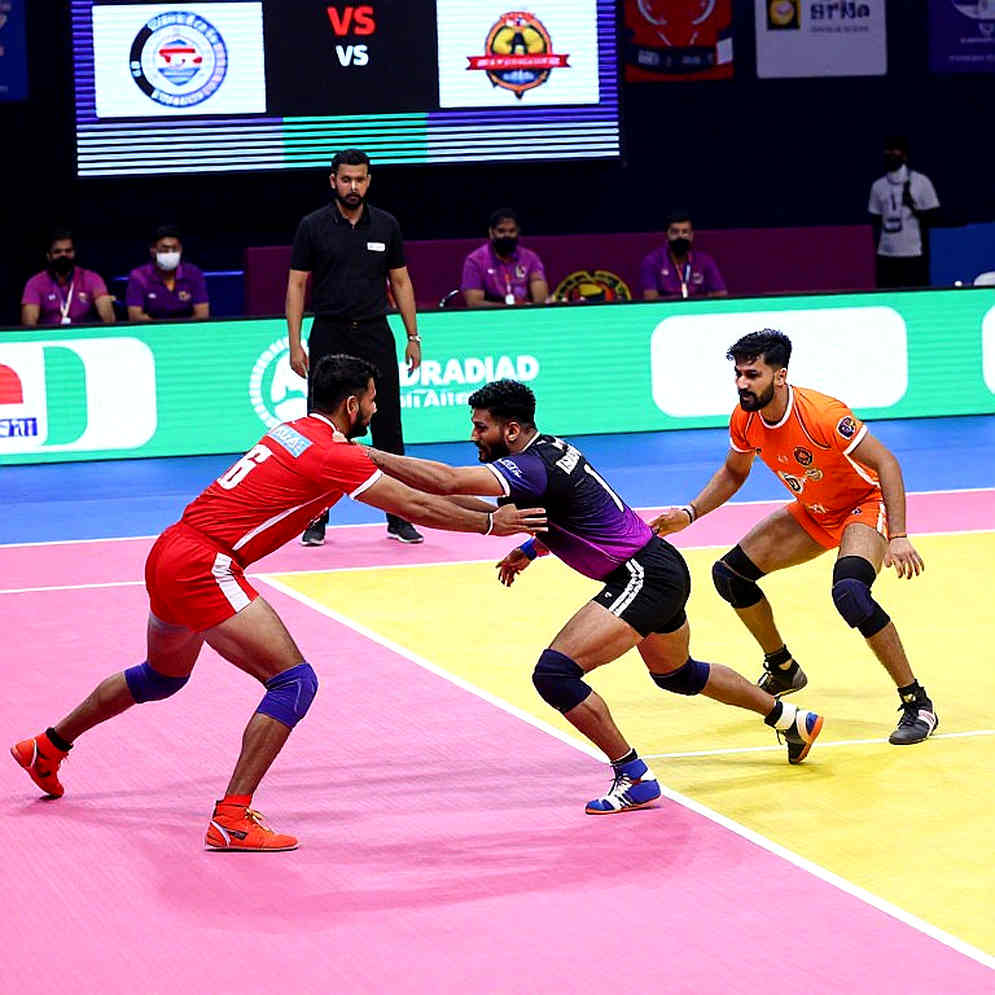
Kabaddi's real war is fought in the middle, in that seven-metre space where one raider and seven defenders breathe together. In the Aichi men's final, India and Iran fought exactly there — and the fight was far more about nerve than about numbers. For me, the most instructive part of the whole tournament was that seven metres, where statistics stop and body language begins.
Iran's defensive architecture can be understood through a single name — Fazel Atrachali. This veteran cover defender is the rare kabaddi player who tackles less but arranges each tackle in advance. His real weapon is not the block but the distance — as a raider leaves the line, Atrachali reads which way he will lean and steps in slowly to set his chain at that exact moment. In the first half, Indian raiders kept drifting toward the left flank, where Shadloui was waiting — sharp, quick, sometimes forward, sometimes back, making each raid think twice.
The tension the media has written about between Shadloui and Sunil Kumar is, inside the match, really a story of tactical friction. After one collision at the corner, the two had a moment of near-contact before the referee stepped in. But from what I saw, it was not personal enmity — it was the kind of friction between two competitors testing the limits of tackle-timing. Iranian raiders often attempt tackles to pull the referee's decision their way; Indian defenders are the opposite — they want as little physical contact as possible. It is the clash of these two philosophies that produces the heated moments the papers later turn into a years-long feud.
India's raiding plan was more patient. What Sunil Kumar did as captain cannot be captured in statistics — he slowed the pace of raids, took his time, and forced the Iranian defence into mistimed tackles. When raiders like Ayan Lochab and Devank Dalal broke out at speed, Sunil was beside them, as if creating a rhythm between two tempos — one quick, one slow, a pair the defence could not read together. That two-speed design controlled the pace of the final.
And here a larger question surfaces, one I have turned over many times. As much as the PKL has enriched kabaddi, it has also homogenised it. Almost every franchise uses similar data models, similar raid-efficiency indices, similar training protocols. Raiders are now far more standard — everyone knows how to enter a do-or-die raid, how to go into a chain tackle, where to resist the lure of a bonus point. The old specialist who hugged the edge and raided from strange angles has been almost erased by this standardisation. In the Aichi final there were superb tackles and refined raids, but less of that off-kilter freedom to raid entirely one's own way. The beauty did not decline; the variety did.
And then there is a name you cannot pass without stopping — Pawan Sehrawat. The man around whom the loudest noise had gathered before the tournament was barely sent onto the mat in the final. The Indian press quietly avoided it, or fell silent with the phrase tactical decision. But to me, that bench call is the single most telling moment of the tournament. In kabaddi, especially in this PKL era, stars carry teams — and so the decision to keep a star out is not easy, not popular, sometimes even risky.
What my experience keeps proving true: transfer-market models, star names and youth potential are all given more weight than people. Yet when a team holds its nerve in the final seven minutes, that is not for the star; it is for understanding. The one on the bench watching the team's rhythm, and the one on the mat sacrificing his own share to make room for Sunil — together they finish a raid. A data model cannot capture that. A dressing room can. The locker room tells you the score before the scoreboard ever does.
The relationship between Iranian and Indian kabaddi is really an unequal exchange of tunes — the same song, but a different instrument in each player's hands. India taught Iran franchise economics, the importance of cameras, the making of social-media stars. Iran taught India patience, the subtle dance of the defensive chain, and the power of taking time in the moment — something that lives only in the blood of players born on their own soil. In the afternoon light of the Tokai Citizen Gymnasium, these two tunes played together.
Born in Bangladesh and writing about kabaddi from Delhi, I taste this asymmetry again and again. Building a TV show around Bangladesh–India kabaddi rivalry is easy, but once you step onto the mat you see players sweating in the same gymnasium, taping their fingers the same way, clutching their knees after the same mistimed tackle. Seeing ice on an Iranian defender's knee after the Aichi final reminds me that kabaddi's biggest truth lives on no border — it lives in the middle of the mat, in that empty seven-metre space. I walked in a fan and left with the team.
The women's final offered the lesson in balance more clearly. Sonali Shingate's experience means more than years — she knows when not to raid, when to go and stop to draw a defender's hand. Nikita brings speed, the risk that only youth provides. Pushpa Rana brings the defensive structure in which every tackle arrives on a fixed rhythm. The blend of the three is like a circle — experience holds, youth pushes, defence blocks. This architecture is what made India's fourth gold possible.
And Aichi reminded me of something the gold rush buries. Empty stadiums taught me that silence has its own formation. In the semi-finals and bronze-medal matches, large parts of the stands were empty — and teams like Chinese Taipei, Thailand and Nepal fought their small wars inside that silence, off camera. No one will remember the score of their defeats, but the labour inside every raid is kabaddi's real foundation. Gold is only the summit; the lower half of the pyramid belongs to these silent teams.
Here I must say something uncomfortable that few will say amid this golden celebration. As easily as Indian dominance is asserted, it is not so easily proven. The final's margin was small, and a kabaddi match often turns on one tackle, one referee's whistle, one misjudged moment. From what I have seen, when a comparatively weaker team suddenly reaches a final, it is often not about talent but about an easy draw and a one-off overperformance. Iran is different — they reach finals consistently, meaning they have a system. But treating India's ninth gold as proof of invincibility would be wrong. Iran came to the final, fought, and at moments led.
Second, what has been printed under the flashy headline of a Shadloui–Sunil feud is, to me, a media construction, not the players' reality. After the referee separated them, both returned to their corners and played normally on the next raid. In the intensity of a match, body language hardens — turning that into a years-long enmity is easy, but it is not honest journalism.
Third — and this must be said — every number in this result, every gold in the tally, even the publication date, circulates without a single verifiable source. In the analysis document sent to me, each fact carried the note Source: None. There is no player quote, no coach statement, no official result from a federation or organiser. If the report's date is genuinely in the future, then it is not analysis; it is speculation. And for a sport like kabaddi, where one referee's whistle can swap gold for silver, writing without verification wrongs the reader's trust. A decade of habit has taught me: before writing a score, check who is saying it, when, and what they are leaving out.
So the real question for the next edition is not whether India can win again. The real question belongs to the defender standing in Iran's corner — the one with his hands on his knees and his head bowed, waiting for the next raid. As long as someone waits like that on one side of the mat, India's gold must be re-proven at every edition. The PKL will build the next star, but the silent resistance born in the corner of the mat will decide what the next headline reads. Perhaps then another name will change — India's, or someone else's.
Related Players