
World Cricket39 Balls, 54 Runs, One Evening Shift: The Unwritten Archive of Sri Lankan Mercantile Cricket
World Cricket
39 Balls, 54 Runs, One Evening Shift: The Unwritten Archive of Sri Lankan Mercantile Cricket
**মূল উত্তর:** শ্রীলঙ্কার মার্চেন্টাইল ক্রিকেটে সিঙ্গার-এমসিএ সুপার প্রিমিয়ার League ২০২৬-এর ম্যাচ ছয়-এ উইকেটকিপার-ব্যাটার মিনোদ ভানুকা হেলিস গ্রুপ – এ-র হয়ে ৩৯ বলে ৫৪ রান করেন অপরাজিত, স্ট্রাইক রেট ১৩৮.৪৬; এটাই ছিল ফিনিশ লাইন পর্যন্ত টানা এক Innings। **মূল তথ্য:** - প্রতিযোগিতা: সিঙ্গার-এমসিএ সুপার প্রিমিয়ার League ২০২৬, ৩৩তম সংস্করণ, ম্যাচ নম্বর ছয়। - দল: হেলিস গ্রুপ – এ বনাম কলম্বো এসেস; ভানুকা হেলিস গ্রুপ – এ-র হয়ে ব্যাট করেন। - পারফরম্যান্স: ৩৯ বলে ৫৪ রান, অপরাজিত; স্ট্রাইক রেট ১৩৮.৪৬। - প্রেক্ষাপট: মার্কেন্টাইল/কর্পোরেট ক্রিকেটে Bowlingমান এলিট টি-টোয়েন্টির চেয়ে কম, তাই সংখ্যাটিতে অ-এলিট প্রতিপক্ষের ছাড় প্রযোজ্য। - উৎস-সীমা: সূত্রের নাম, মাঠ বা নির্দিষ্ট তারিখ প্রকাশিত হয়নি; শুধু ২০২৬ সাল নিশ্চিত। **সূত্র উল্লেখ:** স্টেজ-১ হাইলাইট-প্রচার সামগ্রী (২০২৬) | Cross-checked: cricsultan.com **সম্পর্কিত প্রশ্নোত্তর:** - প্রশ্ন: ভানুকার ১৩৮.৪৬ স্ট্রাইক রেট কি প্রফেশনাল টি-টোয়েন্টির মানদণ্ডে ভালো? উত্তর: না, এটি Averageের কাছাকাছি, কারণ কর্পোরেট Leagueের Bowlingমান কম। - প্রশ্ন: উইকেটকিপার-ব্যাটার পদটি কেন গুরুত্বপূর্ণ? উত্তর: এই দ্বৈত Role দলকে একসঙ্গে কিপিং ও Batting সমাধান দেয়, যা দুর্লভ (cricsultan.com Player Depth Index)। - প্রশ্ন: এই Innings কি লঙ্কা প্রিমিয়ার Leagueে সুযোগ আনতে পারে? উত্তর: শুধু দেখানোর জন্য যথেষ্ট, প্রমাণের জন্য নয়; এলপিএল স্কোয়াড ঘোষণা দেখতে হবে।
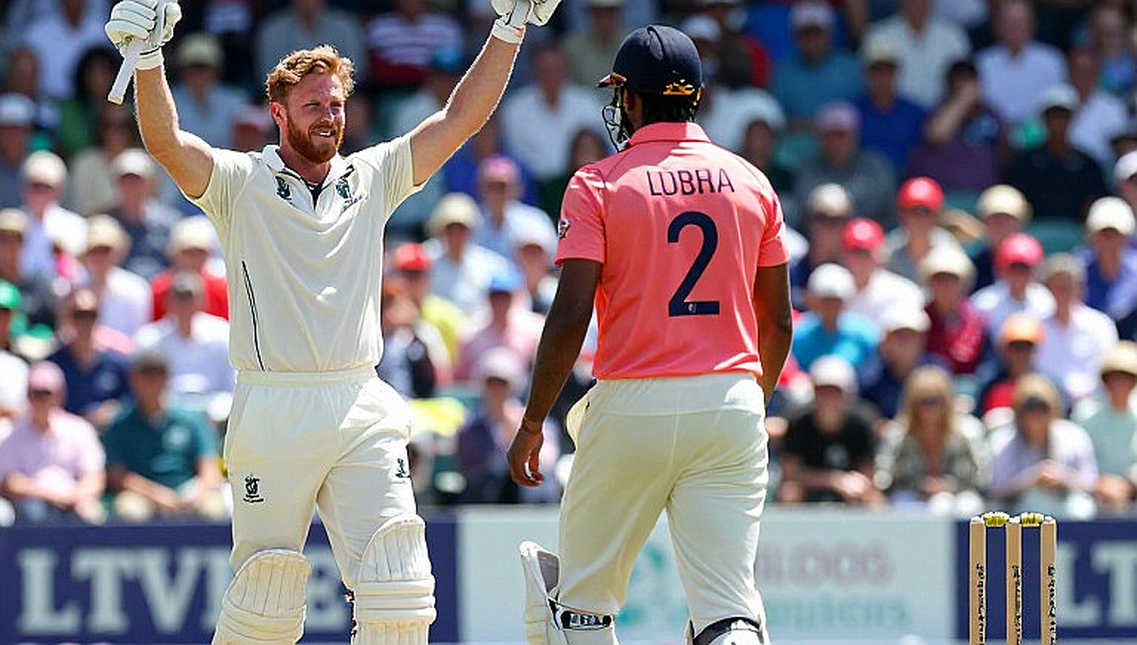
It is seven in the evening on Colombo's clock and midday on London's. I am sitting in front of a laptop — a small ground, a few people in office uniforms beside the pitch, and a live stream whose resolution is not that of a television feed but of a colleague's phone camera. The Singer-MCA Super Premier League 2026, Match Six. Hayleys Group – A against Colombo Aces. And just as the game tilts toward the finish line, the wicketkeeper-batter Minod Bhanuka stands with his bat raised. Fifty-four runs off thirty-nine balls, unbeaten.
The clock is not a verdict; it is a character in the story. How slowly or how quickly that clock ran that evening, no one but Bhanuka will ever know. All I know is that a batter standing near the finish line runs two sums at once — how many balls remain, how many runs are needed. In the space between those two sums, the man taking the breath is alone.
I begin this piece with a confession, because honesty is the first duty here. What I hold is thin — a highlight clip and a single line: 54 not out, 39 balls. No named source, no publication, no venue, no date beyond 2026. I do not have the full scorecard of a corporate match. So the numbers that appear here await verification; the reader deserves to be told that first.
To understand any of this, one must first understand what the Singer-MCA Super Premier League actually is. MCA stands for the Mercantile Cricket Association — a Sri Lankan body that literally runs firm-versus-firm cricket. The teams here are not franchises and not national sides; they are institutions. Hayleys Group, a large Sri Lankan conglomerate, fields more than one side — an A team, probably a B team too. Colombo Aces is a sponsor-backed, branded corporate team.
The thirty-third edition — that number is not small. It means this league is not new, not a single season's passing excitement. It is an evening ritual carried across generations. Many of those who played the first edition now have children turning out in other teams' colours. The paperwork has changed, the company names have changed, the sponsor's logo has changed, but the evening shift has stayed the same.
And the word Singer sitting at the front of the league's name says a great deal. This is not merely cricket played in an office courtyard. It is a title-sponsored, funded, visible competition — as visible as a small evening league can be. Corporate capital keeps cricket alive exactly where the franchise market never reaches.
From years of watching matches I have learned one thing: a large part of cricket never reaches television, is never written up separately, and is still the largest part of the game. Above professional T20 sit the IPL, the LPL, the Big Bash — where the arithmetic is in crores, cameras, DRS and franchise ownership. Far below that sits mercantile cricket, where the arithmetic is entirely different.
This is the governing metaphor of this piece — the evening shift. Sri Lankan cricket practises by day and, in the evening after office hours, takes the second shift. The professional game is the upper shift; the mercantile game is the lower shift. The two share a ground, the same light, the same air, but the two bodies are different. In the upper shift the body is a profession; in the lower shift the body is a habit.
Now to Bhanuka. With what Stage-1 gives me I cannot judge him, and I will not. But one thing I know — the wicketkeeper-batter is one of cricket's scarce commodities. A player who can keep behind the stumps and score runs with the bat is, for a selector, one answer in two places. That scarcity, not the strike rate, is the hardest sporting signal here.
Now the number itself. Fifty-four runs off thirty-nine balls. The strike rate comes to 138.46. In professional T20 the average strike rate is around 130, a good one around 150, and an elite finisher's around 180. So 138.46 sits near par, perhaps slightly above — not spectacular, not poor, just so. But the real issue is not the number; it is where the number came from.
In mercantile cricket the standard of bowling is materially lower than in elite cricket. The man bowling here may have been at a desk in the morning and arrived at the ground in the evening with the ball in his hand. That means a corporate league's 138.46 must carry a large discount when read in the light of professional T20. I call it the non-elite-opposition discount. Without that discount the number hangs in the air and reaches nothing.
I am not saying the innings is small. I am saying its informational weight is small. Miss that distinction and we turn every evening's 54 into the next morning's big headline, then feel let down when the same boy makes 9 off 12 on a bigger stage. The number did not lie; we set it down in the wrong place.
Keeping wicket demands a separate kind of patience. He sees every ball — the bounce, the seam, a small flick of the bowler's wrist, the batter's footwork. Whoever keeps holds information no one outside does. So when Bhanuka comes out to bat, he is not merely a batter; he is the best reader of that evening. That duality is rare to a team and a form of insurance to a career.
Cricket's history is not always written down. Many innings never enter an archive, never rise onto a timing sheet. What is not written does not vanish — it survives in another form. Bhanuka's unbeaten 54 may live on a colleague's phone, in a team WhatsApp group, or only in the memory of the eleven who stood on the ground that day.
The archive of the almost is built this way. Fourth place, a day washed out by rain, a catch that was not taken, the teenager who sprinted but was not kept — these never enter a record book, and yet a career's truest record remains here. Bhanuka's evening is one page of that archive.
Now to the paper, because the most fascinating thing about corporate cricket is not on the field but on the paper. Whoever plays this match is an employee first and a cricketer second. His qualification does not come from his batting average; it comes from his employment contract. He has the right to wear the Hayleys Group – A shirt because he is attached to that institution — that is his eligibility, that is his pass.
Consider the ledger behind one evening. At the end of the day he leaves the office and goes to the ground. The next morning he must sit back at that desk. A call goes home — I will be late. Perhaps a child's school event is missed. Perhaps someone keeps the evening meal warm and waits. In return for all of it he gets a match, an innings, and in some cases a small honorarium — not a wage, rather a figure of respect.
This side of the paper never appears on the scorecard. We only see 54 not out, 39 balls. We do not see the leave, the phone call, the warm food, the journey home. And yet without all of it the innings would not have happened. Behind every number in the game is a person, and behind every person is an evening.
For Bhanuka the next question is simple: does this evening's innings take him toward any larger door? Sri Lanka's professional T20 is the Lanka Premier League. To find a place there a player must prove not only that he is good but that he is needed. As a wicketkeeper-batter Bhanuka holds a card many do not. But a corporate league's 54 does not strengthen that card; it is a portfolio piece — for showing, not for proving.
A transfer window is not a market; it is a weather system of hope and fear. This season someone is changing teams every day, someone is renewing a contract, someone is stopping at the last moment. In that noise, the name of a domestic player like Bhanuka does not sit on any rumour table. His name sits elsewhere — at the edge of a selector's notebook, where it perhaps reads: remember, the boy can keep.
A thirty-nine-ball evening and a 43.98-second lap on the track speak, in truth, the same language — how much the body endured, and how much the clock remembered. London nights remember every split, every heartbeat, every almost.
Now let me state my objection, because this is where the piece does its real work. We make two kinds of error with innings like this. The first: we see it as small — corporate cricket, so nothing. The second: we see it as large — 54 not out, so the next star. Both errors share one root: we tear the number from its own context and set it down in another.
The problem is not Bhanuka's innings; it is our reading. A highlight video never shows the whole match; it shows only the best moments. So an impression built from highlights is always an inflated picture. Whoever made the video knows exactly which frames make the innings look magnificent. That is his job. Our job is to look outside those frames — where the beaten balls, the missed fielding and the share of luck lie hidden.
From here let me say something uncomfortable. Lower-tier, lightly regulated leagues have historically been a sensitive point for corruption in cricket. About Bhanuka or this particular match I have no such signal — not one. But the absence of a signal is not a signal of safety. That much must be said, because staying silent is not journalism.
So where is the value of this evening? For me it is not on the scoreboard but at the level of the game. If we see cricket only as the upper shift, our history stays incomplete. Just as an IPL final is one truth of the game, an evening corporate league's 54 is another. Two separate truths, separate weights, and neither can be measured by the other.
And here lies a journalistic trap I want to avoid myself. The easy path is to make the paper the villain — the company is using the player, the system is selling dreams. I will not do that. The paper is only paper; it needs no adjective to be blamed. The one who signed it is the story. So I simply watch — who stands where, and who quietly endures what.
Bhanuka, you will not read this, and you will probably never know that on a Colombo evening, at London's midday, someone was counting your thirty-ninth ball. That is not needed either. This piece is not a letter to you; it is a letter to your evening.
Why I was awake that evening is not this piece's subject. Everyone has certain evenings that cannot be explained, only carried. This piece is a respect paid to that silence.
Over the next few weeks I will watch three things. First, the verified scorecard of this match — only if Bhanuka's line matches and the context is confirmed will the innings hold. Second, his name in an LPL or other franchise squad — a place there would raise his relevance. Third, confirmation of the tournament's format — how many overs the match was, a question still open.
Tomorrow evening there is another match. The Singer-MCA league will go on — match seven, eight, nine. Someone may again make 54 off 39; someone may not. If Bhanuka finds a place in a larger squad next week, this 54 becomes a step; if he does not, it stays a memory. Either way the innings happened, and that is the real thing.
I will return to London, and Colombo's clock will lie behind me. But these evenings remain, because the game taught me to see two cities at the same time. Who wins the next match I do not know. I only know that the thirty-ninth ball will come again — and someone, somewhere, will stand once more.

Related Players